What is the difference between venting and flaring?
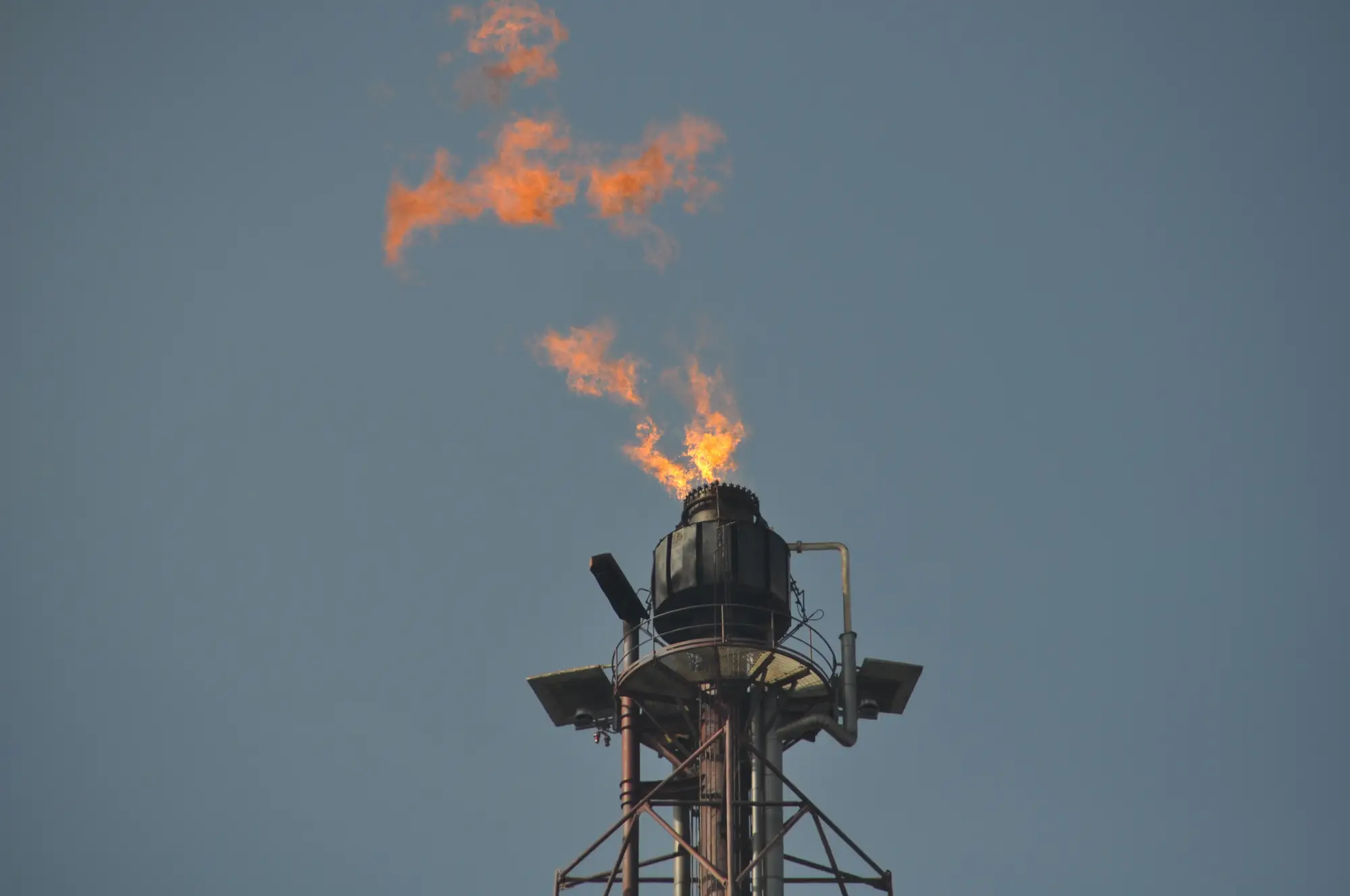
Both terms describe ways operators get rid of gas they can't capture or sell. The confusion between them shows up constantly in regulatory filings, ESG reports, and even in operator disclosures that use the words loosely. The distinction is simple on paper and important in practice, because the two processes produce very different emissions profiles.
Venting: gas released without combustion
Venting means letting gas escape to atmosphere unburned. At a wellhead, this might happen through pneumatic controllers that bleed gas as part of normal operation, through casinghead gas released during liquids unloading, or through intentional "cold venting" when a facility has no flare system or chooses not to use one. Whatever the source, the gas goes up raw. For associated gas from oil wells, that's mostly methane, plus varying amounts of heavier hydrocarbons, CO2, and trace compounds.
Methane has a global warming potential many times higher than CO2 over a 20-year horizon. So a vented stream, molecule for molecule, does more near-term climate damage than the same volume burned off. That's the core reason regulators have pushed operators toward flaring over venting in jurisdictions where gas can't be captured, even though flaring isn't emissions-free either.
Flaring: gas burned before release
Flaring routes the gas through a stack and ignites it before release. Combustion converts most of the methane to CO2 and water vapor. "Most" is doing real work in that sentence: flare combustion efficiency depends on flame stability, gas composition, wind conditions, and whether the flare is lit at all. A poorly tuned or unlit flare stack can leak nearly as much raw methane as straight venting, just with extra soot and NOx on top. Combustion efficiency in the field often runs well below the 98% assumed in many emissions factor calculations, which is one reason flare-based emissions estimates built purely on operator-reported volumes tend to understate actual output.
So the practical difference isn't just burned versus unburned. Flaring, done correctly, shifts the emissions profile toward CO2 and away from methane, lowering the near-term climate impact per unit of gas. Venting skips that conversion entirely.
Why the distinction matters for emissions reporting
For regulators tracking compliance and ESG analysts scoring operators, the venting-versus-flaring split feeds directly into Scope 1 accounting and methane intensity figures. A field reporting high flare volumes but low methane emissions is making an implicit claim about combustion efficiency that's rarely verified independently. A field with permitted venting allowances has a different regulatory exposure than one flaring continuously, and permit terms, royalty calculations, and emissions inventories all hinge on which activity is actually happening and at what volume.
The problem is that most of this data comes from the operator. Flare and vent volumes reported in regulatory filings or sustainability disclosures are self-measured, often estimated rather than metered, and updated on whatever cadence the filing requires, which for many jurisdictions means quarterly or annually. A flare that's been unlit for three weeks, or a stack that's flaring well above its permitted volume, doesn't necessarily show up until the next reporting cycle, if it shows up at all.
That gap between self-reported flare activity and what's burning at the wellhead is exactly where an independent count becomes useful. Night-time and SWIR satellite imagery picks up flare thermal signatures directly, giving regulators and fund analysts a nightly log of flare count and size across a monitoring area instead of waiting on the next operator filing. It won't tell you whether a given flare is venting unburned methane through poor combustion, but it does tell you flares are lit, how many, and roughly how large, as a standing proxy for production and emissions activity between official reports.
If you're trying to close that gap between filed numbers and ground truth, Flare Monitoring is built for exactly this read.